AI Pair Programming Isn't Killing Teamwork — It Might Actually Be Fixing It
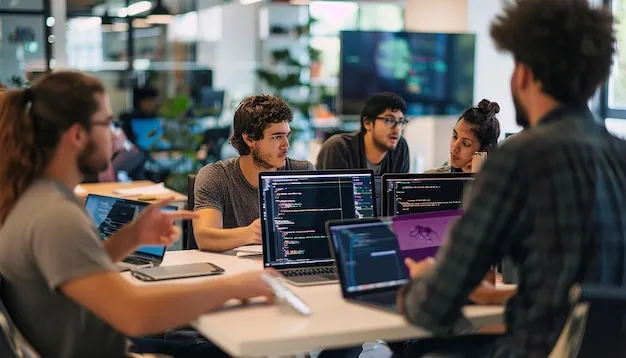
Photo: diverse software development team collaborating around monitors in modern office, via img.freepik.com
Let's address the concern head-on: a lot of engineering managers are quietly worried that AI coding assistants are turning their teams into a collection of highly productive individuals who have no real reason to talk to each other anymore.
It's a fair concern on the surface. When a junior dev can ask an AI to explain a concept, get a code review from a bot, and generate a working implementation without ever pinging a senior colleague — what's left to collaborate on?
As it turns out, quite a lot. And some of the most forward-thinking dev teams in the country are figuring out how to use AI not as a replacement for team dynamics, but as a surprisingly powerful amplifier of them.
The Myth of the AI-Isolated Developer
The "AI makes developers antisocial" narrative makes intuitive sense but falls apart when you look at how high-performing teams are actually operating. The issue isn't that AI tools reduce the need for collaboration — it's that they change what collaboration is focused on.
Before AI pair programming tools became mainstream, a significant chunk of team interaction was transactional: "How do I write this regex?" "What's the syntax for this API call?" "Can you help me debug this loop?" These are useful conversations, but they're not exactly the stuff of great engineering culture.
AI handles most of that now. And what's left — the genuinely meaty discussions about architecture decisions, edge case reasoning, product tradeoffs, and long-term maintainability — those conversations are actually happening more on teams that have embraced AI tools thoughtfully.
A staff engineer at a fintech startup in Chicago described her team's experience this way: "We used to spend the first twenty minutes of every PR review explaining what the code was doing. Now everyone comes in having already read it, often with AI-generated summaries to reference. We spend the whole review talking about why decisions were made. The quality of feedback went through the roof."
AI as a Shared Cognitive Layer
Here's a reframe that changes everything: stop thinking of AI coding assistants as individual productivity tools, and start thinking of them as shared infrastructure for your team's thinking.
When every developer on a team is working with the same AI tooling — same IDE integrations, same context windows, same prompting conventions — something interesting happens. The AI becomes a kind of common language. It creates a baseline of consistency in how code is drafted, documented, and explained.
This has real implications for a few team dynamics that have historically been hard to get right.
Code Reviews That Actually Teach
Code review has always been one of the most valuable — and most underutilized — learning opportunities in a dev team's workflow. In practice, it often devolves into nitpick sessions about formatting and naming conventions, with the deeper architectural feedback getting skipped because everyone's too busy.
AI tools are absorbing the nitpick layer. Linters and AI-assisted review tools catch the surface-level stuff automatically, which means human reviewers can focus their limited attention on the things that actually require human judgment. Teams that have made this shift report reviews that are faster, less contentious, and more educational for the people receiving feedback.
Mentorship That Scales
Mentorship is one of the hardest things to scale in a growing engineering organization. Senior developers only have so many hours, and junior developers need a lot of ramp-up time. It's a math problem that never quite works out.
AI pair programming tools are starting to change that equation. When a junior developer can get instant, contextual explanations for code they don't understand — and can experiment with AI-suggested approaches in real time — the volume of basic questions hitting senior team members drops noticeably.
That doesn't mean senior developers become less important. It means their mentorship time can be spent on higher-value conversations: career development, system design thinking, navigating organizational complexity. The stuff you genuinely can't get from a chatbot.
Knowledge Transfer That Doesn't Disappear When Someone Quits
Every engineering team has experienced the quiet panic of a key developer giving two weeks' notice and taking years of undocumented institutional knowledge out the door with them. It's one of the most persistent and painful problems in software development.
AI tools are beginning to address this in meaningful ways. When developers are consistently using AI to generate inline documentation, write commit message summaries, and annotate complex logic, the codebase itself becomes more legible over time. Teams that enforce AI-assisted documentation as part of their workflow are building something genuinely valuable: a codebase that can explain itself.
A Practical Framework for Teams Getting Started
If you're an engineering lead looking to move from "everyone uses AI individually" to "AI makes our team better collectively," here's a starting point that's worked for several teams we've spoken with.
1. Standardize your tooling first. Mixed AI environments create inconsistency. Pick a set of tools — whether that's GitHub Copilot, Cursor, or another IDE-integrated assistant — and get the whole team on the same page. Consistency is what makes AI a shared layer rather than a collection of individual habits.
2. Build AI into your review process explicitly. Don't leave it up to individuals to decide whether they use AI in code review. Make it part of the workflow. Require AI-generated PR summaries. Use AI-assisted diff tools as a first pass. Then let humans focus on what humans are actually good at.
3. Create prompting conventions as a team. How you prompt an AI matters enormously for output quality. Teams that develop shared prompting conventions — especially for common tasks like documentation, test generation, and refactoring — get dramatically more consistent results than teams where everyone is winging it.
4. Protect space for human-only discussion. This one's counterintuitive but important. The best teams using AI aren't using it in every moment. They're preserving certain conversations — architecture reviews, retrospectives, design sessions — as explicitly human spaces. This keeps team relationships strong and ensures that AI is augmenting judgment, not replacing it.
The Collaboration Upgrade Nobody Saw Coming
The fear that AI tools would atomize development teams into a bunch of solo operators hasn't played out on teams that approached the transition thoughtfully. If anything, the opposite is true: AI is quietly clearing away the low-value friction that used to eat up team bandwidth, making space for the kind of collaboration that actually moves the needle.
The teams winning right now aren't the ones where everyone is the most individually productive. They're the ones that figured out how to make AI a team sport.
And honestly? That's a much more interesting future for software development than the isolated-genius narrative ever was.